Scaling a multi-vendor marketplace across Africa requires robust vendor onboarding, real-time inventory sync, and automated payouts. Learn how custom portals drive success.
Security2026-09-07
ByGwer Msughter Donatus— Founder & Senior Software Engineer, GITSBuilds payment reconciliation systems, AI automation and production web platforms for clients across 12 countries.
Building Custom Vendor Portals for African Marketplaces: Scaling Multi-Vendor Ecosystems
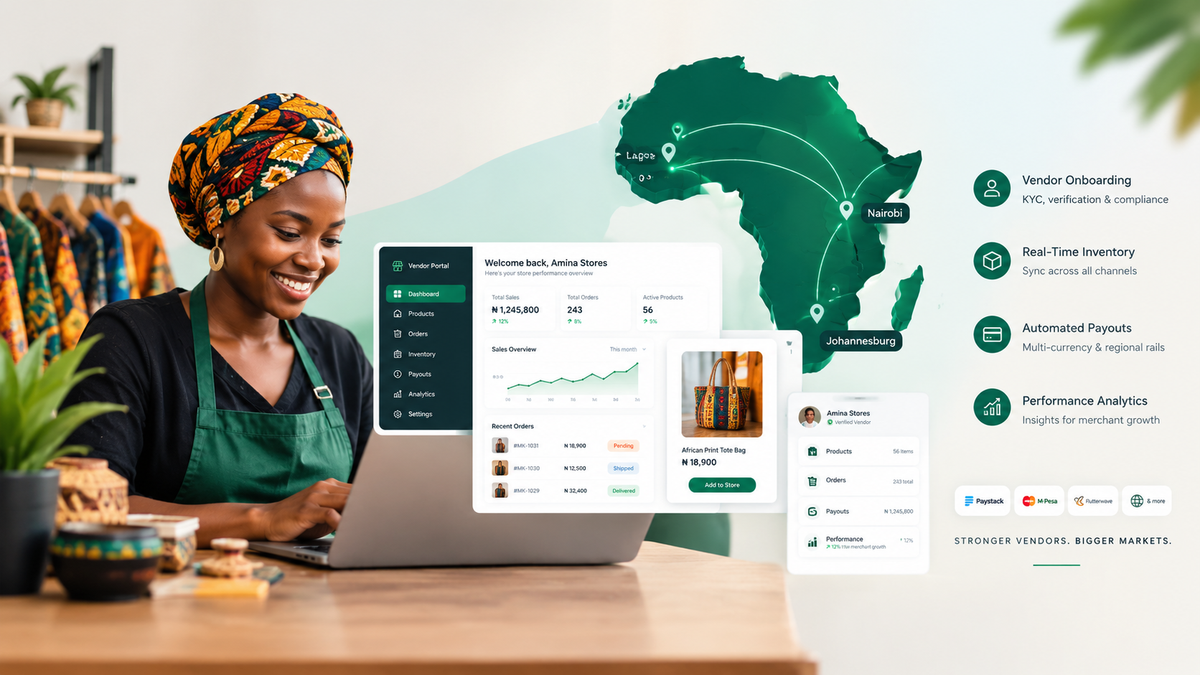
The e-commerce and digital marketplace boom across Africa is accelerating rapidly. From multi-category retail platforms in Lagos and Nairobi to cross-border B2B supply networks, founders are building digital ecosystems that connect thousands of independent merchants with eager buyers. However, operating a multi-vendor marketplace comes with immense operational friction. Off-the-shelf marketplace templates and generic SaaS dashboard tools often break down when confronted with the unique realities of the African market—such as fragmented logistics networks, manual bank settlements, and diverse multi-currency vendor payouts. If your marketplace is scaling, relying on rigid, out-of-the-box vendor management tools will eventually choke your growth. Building a custom vendor portal is the strategic engineering solution needed to streamline operations, build merchant trust, and scale efficiently. 1. Streamlined Vendor Onboarding and Local Compliance Onboarding merchants across different regions requires more than just collecting a name and email address. Marketplace operators must handle local business verification, tax identification, and regulatory compliance (such as NDPR in Nigeria or POPIA in South Africa). A custom vendor portal allows you to integrate automated identity verification and KYC APIs directly into the registration flow. Instead of manual spreadsheet checks, your system can automatically verify business registration numbers, vet merchant profiles, and grant tiered selling permissions based on completed compliance milestones. 2. Real-Time Inventory and Multi-Location Sync One of the fastest ways to destroy customer trust on a marketplace is listing an item as "in stock" when the merchant has already sold it offline or on another platform. Custom internal tools and vendor portals solve this by providing merchants with lightweight, fast-loading dashboards built on high-performance frameworks like Next.js. With real-time webhook integrations, inventory updates sync instantly across the entire marketplace. If a vendor updates their stock level, the change reflects immediately on the storefront, preventing canceled orders and frustrating customer service loops. 3. Automated Split Payments and Regional Payouts Managing money across a multi-vendor platform is complex. When a customer buys items from multiple different vendors in a single checkout, the platform must instantly calculate commissions, deduct marketplace fees, and route the remaining funds to the respective merchant accounts. Generic software often struggles with multi-currency splits and local payout rails. A custom-built vendor backend integrates seamlessly with regional payment infrastructure—such as Paystack, Flutterwave, M-Pesa, or local banking APIs. Automated reconciliation engines can track transactions, detect financial drift, and disburse payouts securely without manual human intervention. 4. Granular Performance Analytics for Merchants Vendors stay on a marketplace when they see clear, measurable growth. Off-the-shelf dashboards usually offer generic, unhelpful metrics. A custom vendor portal lets you give your merchants deep visibility into their specific sales funnels: Conversion Metrics: Track which product listings get the most views versus actual checkouts. Fulfillment Speed: Monitor shipping times and logistics performance to reward top-performing vendors with higher search visibility. Customer Feedback: Aggregate reviews and direct inquiries to help merchants optimize their inventory and service quality. Engineering for Marketplace Success Scaling a multi-vendor marketplace across the continent requires an infrastructure built for clarity, speed, and absolute quality. When your vendor tools are fast, reliable, and tailored to local workflows, your merchants spend less time fighting software and more time selling. At GITS Technology, we specialize in engineering custom software, internal dashboards, and robust API integrations designed for ambitious digital platforms. Partner with us to build custom vendor infrastructure that scales your marketplace.
More posts
View all →Product News2026-09-25
Your Team Is Still Copying Orders From WhatsApp Into a Spreadsheet. So What Exactly Is the AI Doing?
A walk through one ordinary WhatsApp order reveals five different problems — and only one of them actually needs AI.
Product News2026-09-18
Agentic AI in 2026: Why Chatbots Are Dead & Orchestrated Workflows Are the Future
With AI drastically speeding up code generation, the role of developers is shifting to complex system design, security, and scalable architecture.
AI Insights2026-09-18
The AI "Hallucination Tax": Why Your Business Automation is Creating More Manual Work
Are your AI agents creating more manual work? Learn what the "hallucination tax"
UI/UX Strategy2026-09-18
The UX of Trust: Designing Interfaces for Autonomous AI
As AI handles more complex operations autonomously, the primary design challenge shifts from reducing clicks to building trust. Here is how to design observability into automated workflows.